In the fast-evolving world of sports betting, mastering betting odds remains the cornerstone of informed wagering. As we dive into 2026, with mobile apps dominating over 80% of bets, AI-powered live odds, and explosive growth in markets like esports and niche sports, understanding how odds work has never been more critical. Whether you’re a newcomer placing your first wager or a seasoned bettor refining your edge, this comprehensive guide breaks down everything from the basics to advanced concepts tailored for today’s digital landscape.
What Are Betting Odds, Really?
Betting odds represent the probability of an event occurring, as determined by the bookmaker, while also dictating your potential payout. They are not just random numbers—they encapsulate the bookmaker’s assessment of likelihood, adjusted for their margin (often called the “overround” or “vig”). In simple terms, odds tell you how much you stand to win relative to your stake if your prediction proves correct.
In 2026, odds are more dynamic than ever. Real-time adjustments during live events, influenced by big data, player tracking, and even weather APIs, mean that what you see pre-match can shift dramatically. Understanding this fluidity helps bettors spot value before lines move.
The Three Main Odds Formats
Bookmakers worldwide use three primary formats: Decimal, Fractional, and American (Moneyline). Each serves the same purpose but displays information differently. Smart bettors know how to read all three, especially with global platforms allowing seamless switching.
Decimal Odds (European Style)
Popular in Europe, Australia, Canada, and many online sites, decimal odds are often praised as the most beginner-friendly. They show the total payout (including your original stake) per unit wagered.
Example: Odds of 2.50 on a $10 bet mean a total return of $25 ($15 profit + $10 stake) if successful.
- Calculation: Stake × Decimal Odds = Total Return
- Profit: Stake × (Decimal Odds – 1)
Decimal odds greater than 2.00 indicate underdogs (more than even chance of profit), while below 2.00 signal favorites. In 2026, decimal formats shine in live betting apps where quick mental math during fast-paced matches like basketball or esports is essential.
Fractional Odds (British Style)
Traditional in the UK and Ireland, fractional odds express profit relative to your stake. They appear as fractions like 5/1 (“five to one”).
Example: 5/1 odds on a $10 stake yield $50 profit + your $10 back = $60 total return.
- Profit: Stake × (Numerator / Denominator)
- Total Return: Profit + Stake
Odds like 1/2 (favorite) mean you win half your stake in profit. Even money is shown as 1/1 or “evens.” Fractional odds remain favored for horse racing and UK football markets, where they highlight juicy payouts on longshots.
American/Moneyline Odds (US Style)
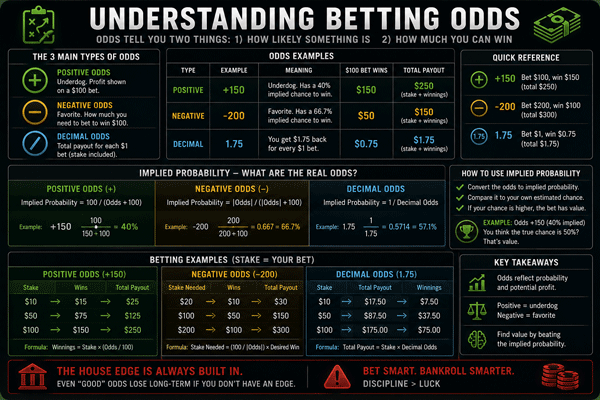
Dominant in the United States, these use positive (+) and negative (-) numbers based on a $100 benchmark.
- Positive (+): Underdog. Shows profit on a $100 bet. +200 means $100 bet wins $200 profit (total $300).
- Negative (-): Favorite. Shows amount to bet to win $100. -150 means $150 bet wins $100 profit (total $250).
Example: A -110 favorite requires betting $110 to win $100. A +150 underdog bets $100 to win $150.
This format excels for moneyline bets in major US sports like NFL and NBA. In 2026, with parlay-heavy betting (now ~35-40% of GGR), American odds make quick favorite/underdog assessments intuitive.
Converting Between Odds Formats
Flexibility across platforms requires conversion skills. Here are the formulas:
- Decimal to Fractional: (Decimal – 1) expressed as a simplified fraction. E.g., 3.50 → 2.50/1 = 5/2.
- Fractional to Decimal: (Numerator / Denominator) + 1. E.g., 3/1 → 4.00.
- American to Decimal:
- Positive: (American / 100) + 1
- Negative: (100 / |American|) + 1
- Decimal to American:
- 2.00: (Decimal – 1) × 100
- <2.00: – (100 / (Decimal – 1))
Implied probability conversions (detailed below) further bridge these. Many 2026 apps include built-in converters, but knowing the math empowers sharper decisions.
Implied Probability: Finding the Bookie’s View
Implied probability translates odds into a percentage chance, revealing the bookmaker’s estimated likelihood (before their margin).
Formulas:
- Decimal: 1 / Decimal Odds × 100
- Fractional: Denominator / (Numerator + Denominator) × 100
- American:
- Positive: 100 / (American + 100) × 100
- Negative: |American| / (|American| + 100) × 100
Example: Decimal 2.00 → 50% implied probability. American +100 → 50%. Fractional 1/1 → 50%.
For a soccer match with odds 2.00 (Home), 3.50 (Draw), 4.00 (Away):
- Implied probs: 50%, ~28.6%, 25% → Total ~103.6% (the overround is the book’s edge, typically 2-10%).
Value betting emerges when your assessed probability exceeds the implied one. In 2026’s data-rich environment, comparing your models or stats against implied probs is key to long-term profitability.
The Bookmaker’s Margin and Overround
The sum of implied probabilities always exceeds 100%—that’s the vig. A fair book would total exactly 100%, but bookies build in profit. Lower margins (e.g., 2-4% on major markets) offer better value. Shop lines across apps in 2026; even small differences compound over time, especially in high-volume live betting.
Popular Betting Markets in 2026
- Moneyline: Straight win.
- Point Spread/Handicap: Levels the playing field.
- Totals (Over/Under): Combined score.
- Props: Player-specific (e.g., yards, goals).
- Futures: Season-long outcomes.
- Live/In-Play: Explosive growth area, now over 50% of activity thanks to streaming integration.
Emerging: Micro-bets in esports, same-game parlays boosted by AI, and crypto-settled wagers on decentralized platforms.
Strategies for Success with Odds
- Line Shopping: Compare across 5+ books. A +150 vs +160 is real money.
- Bankroll Management: Bet 1-5% per wager. Never chase losses.
- Focus on Value: Bet where your probability > implied + margin buffer.
- Specialize: Master 1-2 sports rather than spreading thin.
- Leverage Tech: Use 2026 tools like AI predictors, but verify with your analysis.
Avoid common pitfalls: betting favorites blindly, ignoring closing line value, emotional wagers on your favorite team, or over-betting parlays (high hold but low hit rate).
Trends Shaping Odds in 2026
AI dynamically refines odds using real-time data. Mobile dominance and 5G enable instant in-play action. Legal expansion in new regions, blockchain transparency, and immersive AR/VR betting interfaces are transforming the experience. Sports betting handle continues climbing, with NFL and global football leading, but esports and table tennis surging.
Final Thoughts
Understanding betting odds transforms gambling from luck-based fun into a skill-driven pursuit. In 2026, with more tools and markets than ever, knowledge remains your greatest edge. Start small, practice conversions, calculate probabilities, and always bet responsibly.
Disclaimer: This does not constitute financial advice and to play responsibly and gamble only what they can afford to lose.