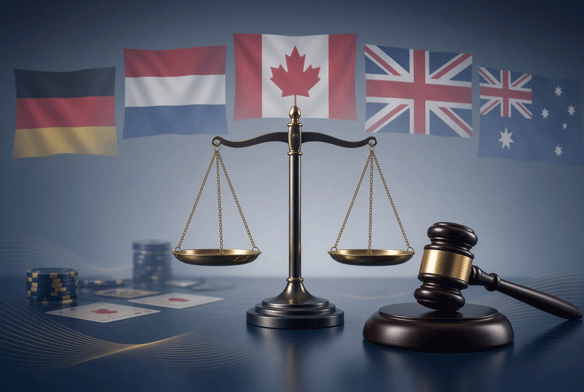
Casino laws vary widely from one country to the next. Some markets run competitive licensing systems with detailed player protections, while others keep tight limits on online products or leave large grey areas for offshore operators. This overview covers the current position for both online and land-based casinos in Germany, the Netherlands, Canada, the UK, and Australia as of mid-2026, set against the broader European move toward stricter rules and stronger channelisation efforts detailed in our legal gambling updates across Europe in 2026.
Germany
Germany’s framework rests on the Interstate Treaty on Gambling (GlüStV 2021). The Gemeinsame Glücksspielbehörde der Länder (GGL) licenses online sports betting, virtual slots, online poker, and horse-race betting at national level. Virtual slots carry some of the toughest product rules in Europe: a €1 maximum stake per spin, no autoplay, a minimum five-second spin, and a monthly deposit limit of around €1,000 for most players.
Online table games such as roulette, blackjack, and live dealer fall under individual state (Länder) control. Most states prefer a monopoly model. A handful, including Schleswig-Holstein, Bavaria, and North Rhine-Westphalia, permit limited private licences that apply only inside that state. As a result, fully licensed nationwide online casinos remain scarce.
Land-based casinos operate legally under state regulation. Offshore sites still draw significant traffic, yet recent European Court of Justice decisions have made it easier for players to recover losses from operators that lack a German licence. The entire GlüStV system faces a formal review due by the end of 2026, which could ease or tighten several of the current restrictions.
The Netherlands
The Netherlands opened its remote market in October 2021 under the Remote Gambling Act. The Kansspelautoriteit (KSA) issues licences covering online casinos (RNG and live dealer), sports betting, and poker. Only KSA-licensed operators may serve Dutch residents. Licences from other jurisdictions do not suffice.
Roughly thirty brands held active licences in mid-2026. The first five-year licences granted in 2021 expire at the end of September 2026, so a major renewal round is under way under updated policy rules that stress affordability checks and duty of care. Operator tax rose to 37.8 percent of gross gaming revenue at the start of 2026. Further proposals under discussion include advertising curbs, bonus restrictions, and possible cross-operator deposit limits.
Land-based casinos remain dominated by the Holland Casino network. Playing at an unlicensed online site exposes operators to enforcement and leaves players without access to the national self-exclusion register (Cruks).
Canada
Canada has no single federal online casino regime. The Criminal Code leaves regulation to the provinces, producing two distinct approaches.
Ontario has run an open multi-operator market through iGaming Ontario and the AGCO since April 2022. Alberta launched a comparable private market on 13 July 2026 under the Alberta iGaming Corporation and AGLC. Everywhere else, government monopolies still prevail: PlayNow serves British Columbia, Manitoba, and Saskatchewan; Loto-Québec runs Espacejeux; the Atlantic Lottery Corporation covers the eastern provinces. Land-based casinos are widely available and provincially licensed. The legal age is 18 in Alberta, Manitoba, and Quebec, and 19 in the remaining provinces.
Players are rarely prosecuted for using offshore sites, though those platforms sit outside provincial consumer protections. Recreational winnings are generally not taxed.
United Kingdom
The UK operates one of the most established open licensing systems. The Gambling Commission requires any operator offering online casino games to Great Britain customers to hold a remote casino operating licence, regardless of where the company is based. Land-based casinos need both operating and premises licences.
Licensed operators must follow detailed Licence Conditions and Codes of Practice that cover age checks, safer gambling tools, advertising, and financial risk assessments. Online slot stake limits stand at £5 per spin for players aged 25 and over and £2 for those aged 18–24. Remote Gaming Duty increased to 40 percent from 1 April 2026, and a statutory levy now funds research, education, and treatment.
The market remains competitive. Recent commercial interest, including SEGG Media’s discussions around UK casino assets, shows that both online and land-based opportunities continue to attract attention, as examined in our analysis of SEGG Media’s UK casino talks and what this could mean for players.
Australia
Australia draws a clear line between land-based and online activity. Land-based casinos operate legally under state and territory licences in most parts of the country.
Online casino games, including pokies, table games, and poker, are prohibited under the Interactive Gambling Act 2001. Operators may not provide or advertise these services to people located in Australia. The Australian Communications and Media Authority actively blocks illegal sites and has received additional enforcement powers through 2026 reforms that also tighten advertising and inducement rules for legal wagering products.
Online sports betting and racing with licensed Australian operators remain legal. In-play online betting faces restrictions. The law targets providers rather than individual players, so Australians are not criminalised for accessing offshore casino sites. Those sites, however, offer no local consumer protection and often encounter payment or access barriers.
Looking Beyond These Markets
Where full online casino products face heavy restrictions, some players turn to cryptocurrency platforms that emphasise speed, privacy, and alternative payment methods, a space covered in our ranking of the top cryptocurrency casinos in 2026.
While the five jurisdictions covered here are relatively mature, other regions continue to develop their own frameworks. Perspectives from people who have examined responsible play and emerging markets can add useful context, including conversations that touch on Latin American developments.
Always check the latest licence status directly with the relevant regulator before playing. Rules change, and operating or playing outside the proper local authorisation carries both legal and practical risks. Gamble only with money you can afford to lose, and make use of the self-exclusion and limit-setting tools available in each market.