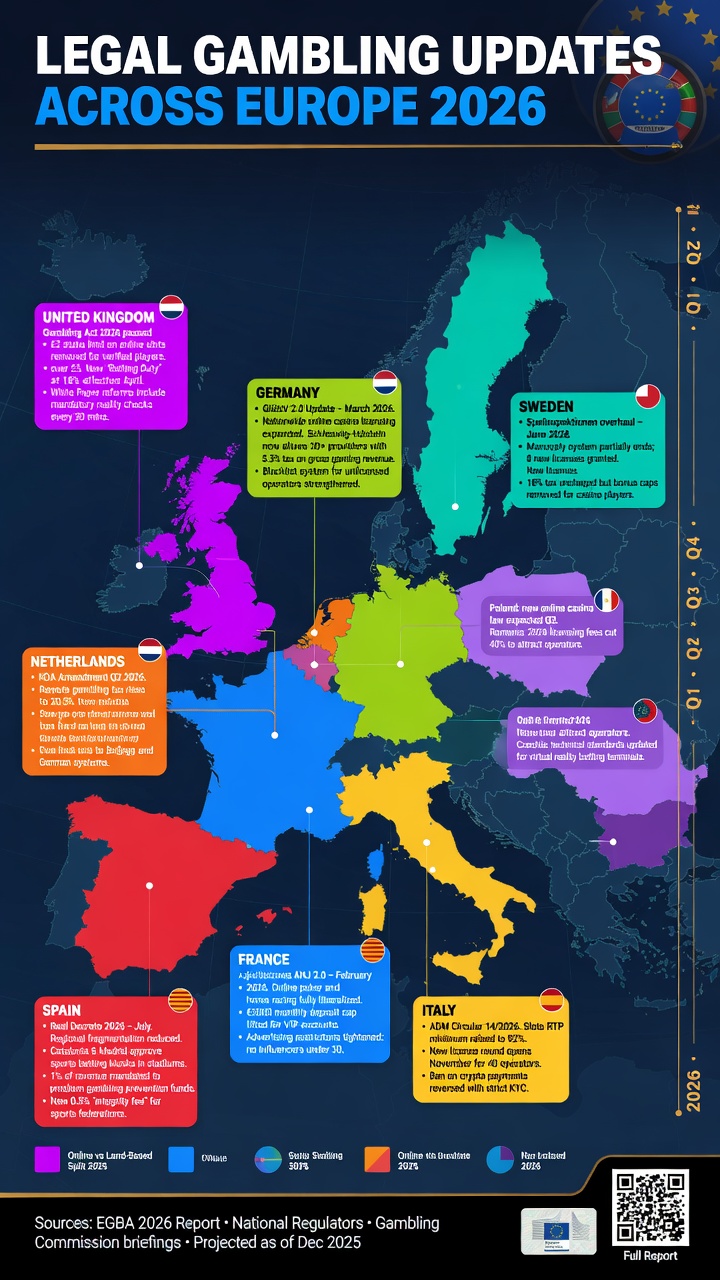
The European gambling market continues its evolution in 2026, balancing robust player protections with opportunities for licensed operators. As digital platforms expand, regulators across the continent are prioritizing channelization—the shift of players from unregulated black-market sites to fully compliant, taxed, and monitored environments. While the EU maintains no overarching sector-specific gambling legislation, leaving autonomy to member states under the Treaty on the Functioning of the EU, coordinated efforts and national reforms are reshaping the industry.
This year marks significant tightening in major markets, driven by concerns over addiction prevention, money laundering, and unfair competition from unlicensed operators. Online gambling is projected to claim a growing share of the market, but stricter rules on advertising, deposits, and responsible gaming tools define the new normal. For players and operators alike, staying informed is essential to enjoying a secure experience.
Coordinated European Push Against Illegal Gambling
A standout development in late 2025, carrying strong momentum into 2026, was the joint statement by gambling regulators from Austria, France, Germany, Great Britain, Italy, Portugal, and Spain. Hosted by Spain’s DGOJ, the agreement emphasizes cross-border collaboration to tackle illegal online offerings, particularly those using digital advertising to reach players across jurisdictions.
This alliance aligns with the EU’s broader ProtectEU strategy and highlights shared challenges like cross-border licensing conflicts. The Court of Justice of the EU reinforced national sovereignty in April 2026 rulings, confirming that member states can enforce bans on certain gambling forms—even against operators licensed elsewhere (e.g., Malta)—when justified by public interest, consumer protection, and social order.
Expect more enforcement actions, including improved blocking mechanisms and intermediary liability under the Digital Services Act. Germany’s planned GlüStV 2021 amendments aim to broaden targeting of access providers for DNS blocking, addressing previous court limitations. Similar measures are anticipated in Austria.
United Kingdom: Major Tax and Safety Overhauls
The UK leads in regulatory intensity. From April 2026, the Remote Gaming Duty rises to 40% on online slots and casino revenue, funding harm prevention initiatives. The UK Gambling Commission (UKGC) enforces statutory stake limits on slots, bans mixed-product bonuses, and rolls out frictionless financial risk (affordability) checks.
Non-remote operators must remove non-compliant gaming machines following notifications under new Licence Condition 18.1.1 (effective July 2026). Advertising faces stricter scrutiny, and player protection tools like deposit limits and self-exclusion are mandatory. These changes, stemming from the 2023 Gambling Act Review White Paper, aim for a safer market but have prompted some UK players to explore EU-licensed options.
Despite challenges, the UK remains a highly regulated, innovative jurisdiction with strong consumer safeguards.
Germany: Evaluation Year and Stricter Limits
Germany’s Interstate Treaty on Gambling (GlüStV 2021) faces a key evaluation in 2026. Regulators focus on channelization success, with potential adjustments to spin durations, deposit limits (€1,000 monthly cap across platforms), and session tools. The OASIS self-exclusion system and player protection measures undergo review to balance accessibility with harm reduction.
Amendments to enforcement rules target illegal operators more effectively. Licensed sports betting, online casinos, and poker thrive under the GGL framework, but strict advertising bans and technical standards (e.g., RNG certification) remain. The market holds huge potential for compliant operators who prioritize responsible gaming.
Netherlands: Age-Based Loss Limits and Ongoing Tightening
The Netherlands continues refining its 2021 licensing regime. From late 2024 rules extending into 2026, operators enforce monthly loss limits: €350 for players under 24 and €700 for those 25+. Enhanced intervention for high-risk behavior, stricter advertising, and no “role model” promotions underscore the player-first approach.
The Dutch market rewards operators investing in compliance and responsible gaming technology.
Italy and Spain: Higher Barriers and Strong Oversight
Italy raised online gambling license fees significantly (up to €7 million for nine-year terms), signaling commitment to fewer, higher-quality operators. Focus remains on AML, taxation, and curbing illegal sites.
Spain’s DGOJ leads in the joint illegal gambling fight and maintains detailed marketing restrictions, bonus controls, and compliance requirements. Both countries exemplify mature regulated markets with robust consumer protections.
France: Selective Licensing
France permits licensed sports betting, poker, and horse racing via ANJ but prohibits online casinos. This partial regulation reflects a cautious stance, with ongoing enforcement against unlicensed operators.
Emerging and Reforming Markets
Finland advances toward liberalization. Applications for private operator licenses open in March 2026, with full services from mid-2027, ending the long-standing monopoly for slots, casinos, and betting.
Ireland implements phased rollout under the 2024 Gambling Regulation Act, establishing a new regulator and licensing framework in 2025–2026.
Sweden, Denmark, Belgium, and others maintain licensed systems with tight advertising rules and player safeguards. Malta’s MGA remains a key licensing hub for pan-European and international operations.
Partially regulated or monopoly systems persist in Austria, Poland, Norway, and Finland (transitioning). Unregulated or banned jurisdictions like Russia and Iceland contrast with the broader European trend toward licensed competition.
Broader Trends Shaping 2026
- Player Protection and Responsible Gaming: Mandatory tools, AI-driven risk detection, and voluntary EU standards for early intervention gain traction.
- AML and KYC Enhancements: Stricter verification, especially under evolving EU AML architecture.
- Taxation and Compliance Costs: Higher duties and license fees pressure operators but support public interests.
- Technology and Transparency: Platform reporting standards and DSA integration improve oversight.
- Market Growth: Online share grows toward 45% by 2029, rewarding compliant platforms.
Playing Smart in a Regulated Europe
Europe’s 2026 gambling landscape offers exciting opportunities within stricter guardrails. Licensed operators provide fair games, secure payments, and strong protections—far superior to unregulated alternatives.
When exploring top experiences, platforms associated with trusted brands like mrwest.win, goldwin.com, or betmaximus.win stand out for their commitment to compliance and player satisfaction in regulated environments.
Disclaimer: This article does not constitute financial advice. Gambling is for entertainment; play responsibly and only gamble what you can afford to lose. Always verify the latest local regulations and use licensed operators. Seek help if needed through national responsible gaming resources.